Austin Light Rail Project: Important Facts for Affected Property Owners

The Austin Transit Partnership (ATP) is moving forward with a 9.8-mile light rail system. ATP estimates that right-of-way acquisition could begin as early as 2026 and that initial construction could start in 2027.

ATP will have to use the power of eminent domain to take the property rights it needs to accomplish the Light Rail Project. Property owners whose property will be affected by ATP’s Light Rail project have constitutionally-protected private property rights.  Impacted property owners have a right to just compensation for the land taken and any negative reduction in value to its remainder property.

Up to 64 businesses and 4 single-family residences will be displaced by the transit project, according to the recently released Draft Environmental Impact Statement (DEIS). The light rail system would also eliminate over 600 on-street parking spaces, mostly from Guadalupe Street, Lavaca Street, and South Congress Avenue.

The proposed light rail corridor would originate at the Guadalupe Street and 38th Street intersection in North Austin, run south through UT Campus on Guadalupe, then run further south through Downtown on Guadalupe, 3rd, and Trinity Streets, and cross Lady Bird Lake on a new dedicated bridge. South of the lake, the route splits into two branches: one continues south along South Congress Avenue to Oltorf Street and the other runs southeast along East Riverside Drive toward Austin-Bergstrom International Airport. Here is a map that shows ATP’s planned route:

US 281 Blanco Relief Route

The Texas Department of Transportation is currently developing preliminary plans to improve 19 miles of highway in Blanco County.  Blanco County borders Kendall County, Comal County, and Hays County.  As the population in Blanco County and its surrounding areas continues to boom, the volume of traffic has increased.  TxDOT has initiated a study investigating highway expansion to provide traffic and mobility relief along US 281.  The Austin District is also conducting a US 281 Feasibility Study in conjunction with the Relief Route study.

The proposed segment stretches from US 290 to FM 306 and includes the US 281/US 290 interchange.  TxDOT maintains that the primary purpose for this project is to enhance highway connectivity and minimize roadway accidents due to high traffic volumes.  The project is currently in the environmental and evaluation phase, working through potential routes including a “no build” option.

TxDOT developed four options and left these options open to the public for comment through April 9, 2024.  All potential routes are directed west of US Highway 281 away from Downtown Blanco and onto the surrounding land.  

Blanco area residents are concerned that the expansion of the highway could affect the historic, small-town feel the city provides.  TxDOT has held public hearings to address the public’s concerns as well as exhibit the various proposed routes. 

The environmental study component of the project will conclude in 2025.  TxDOT will initiate Right of Way acquisitions over the course of the next few years.  Impacted property owners have a constitutional right to be paid just compensation if their land is taken. 

Celina FM 455 Project

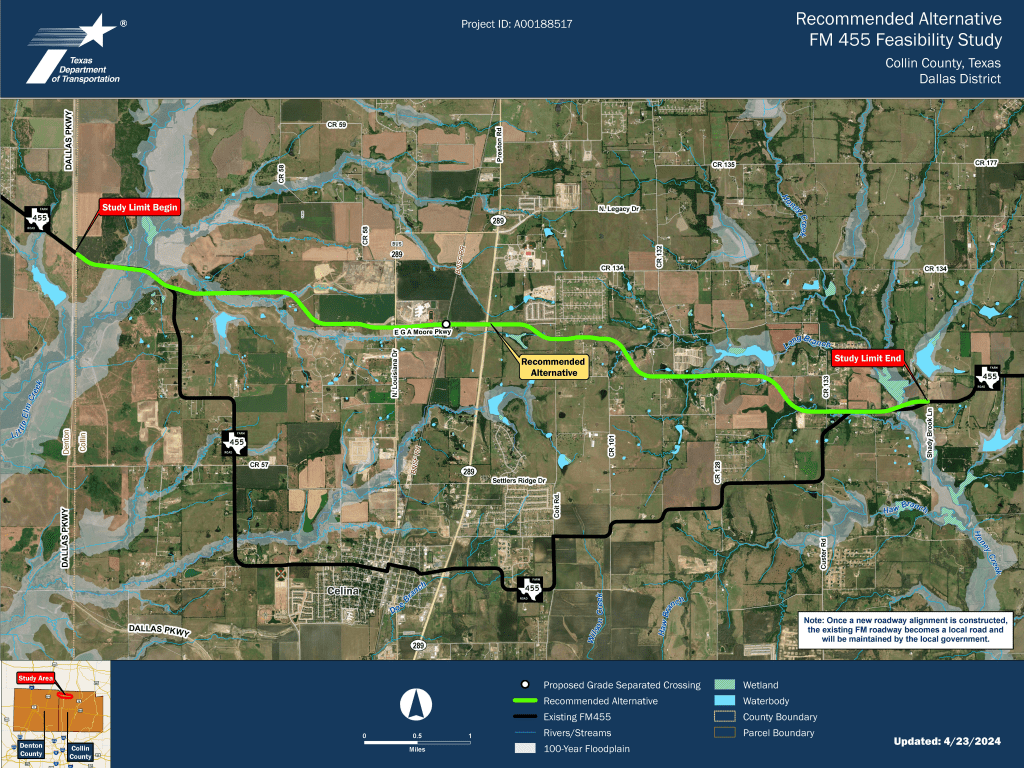
The Texas Department of Transportation (TxDOT) is widening Collin County’s Farm-to-Market Road 455 in a proposed expansion from Dallas Parkway to Shady Brook Lane.  Because the population in Celina, TX has increased by over 26.6% since the year 2000, TxDOT seeks to relieve traffic congestion and inefficient roadways.

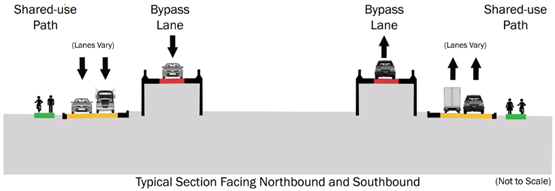
The recommended alternative route for the existing FM 455 is 9.2 miles in length and estimated to cost $129 million.  TxDOT seeks to acquire 65 acres, including a total of 81 parcels with 6 residential displacements as the potential result of this project.  The new roadway expansion will be split into two phases: an interim 4-lane roadway as the first installation, and the construction of the 6-lane roadway will conclude the project.  The proposed ROW will vary between 120 ft – 150 ft.  TxDOT will construct turn lanes at intersections and side streets.  The new lanes will be between 11 and 12 feet.

TxDOT states that it opted for a proposed alternative FM 455 route because expanding the existing ROW does not offer flexible expansion prospects and would condemn a larger volume of properties than that of the new route.  TxDOT completed its feasibility study in summer 2024.  TxDOT’s next steps are determined by the schematic and environmental project phase, where TxDOT will likely also determine the new ROW.

Loop 9 Project

The Texas Department of Transportation (TxDOT) is expanding its road infrastructure from east-west US 67 to I-20 in southern Dallas County, northern Ellis County, and part of Kaufman County. This project is known as Loop 9 with an estimated cost of $297 million. Population growth and economic development in the area encouraged TxDOT to conduct feasibility studies that determined the need for road improvements. The Loop 9 project has been divided into three segments – Segment A, Segment B, and Segment C.   

The proposed Segment A project is approximately 9.4 miles in length bounded from US 67 to I-35E. The project will include an eastbound and westbound 3 lane frontage road, a mainline roadway, and a median that would accommodate the future construction of the mainline roadway. Segment A will be built in three phases. TxDOT is proposing to acquire 597 acres of new right-of-way for Segment A.  This includes 56 residential displacements, 3 commercial displacements, and 1 municipal displacement. Construction is to be determined as funding becomes available.

TxDOT began construction on Segment B in January 2022. The project is bounded from I-35E to I-45 and is approximately 12.1 miles in length. TxDOT has acquired all right of way. This segment is being built in four phases. Phase 1 will require approximately three years to construct and is expected to be open to traffic in 2025. The construction of the rest of the phases will be constructed as traffic and funding is available.

Lastly, the proposed Segment C will begin from I-45 and end at I-20. This would be the last segment to be built and is currently inactive.

RM 620 at Anderson Mill Road Intersection Project

The Texas Department of Transportation (TxDOT) will be making improvements to a 1.2-mile project known as “RM 620 at Anderson Mill Road Intersection Project” from south of Foundation Road to Little Elm Trail, Travis and Williamson counties. It is estimated for construction to cost $45 million. The proposed improvements include the (i) addition of overpasses; (ii) addition of turnarounds; (iii) construction of an additional right-turn lane from northbound RM 620 to eastbound Anderson Mill Road; and (iv) shared-use paths for bicyclists and pedestrians.

Approximately 32 acres of new right-of-way and 0.3 acres of temporary construction easements are required, leading to around 25 commercial displacements. We anticipate right of way acquisition to begin in the next 1-2 months. Appraisers have inspected several property owners’ businesses. Construction is anticipated to start in 2027 according to the TxDOT website. Property owners impacted by this project can seek a free consultation of their case from Marrs Ellis & Hodge LLP.

Update: I-35 Capital Express Central Project

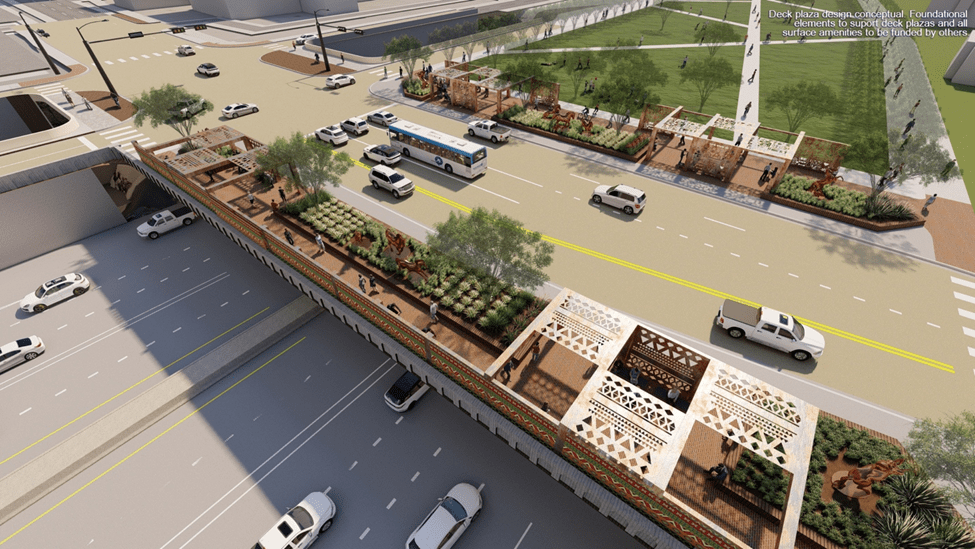
The Texas Department of Transportation (TxDOT) selected Modified Alternative 3 as the preferred alternative on August 21, 2023. This design reduced the number of residential displacements to 26 and business displacements to 69. Modified Alternative 3 will remove the upper decks and adds deck plazas that will allow for other infrastructure and amenities to be built on top. TxDOT is working with the City of Austin and the University of Texas to add this local enhancement and help with funding.

TxDOT has begun filing condemnation lawsuits to take land from property owners impacted by this project. However, there are still some landowners who have not received their initial offer, final offer, or TxDOT’s appraisal. If the final offer is not accepted, the condemnor TxDOT will file their lawsuit which is the first step in the litigation process. If TxDOT continues at this pace, the first phase of construction could begin mid 2024 as stated on its website. Property owners impacted by TxDOT’s I-35 Central Project may reach out to Marrs Ellis & Hodge for an evaluation of their initial or final offer at no cost.

I-35 Widening in Central Austin

The Texas Department of Transportation (TxDOT) is widening 8 miles of Interstate 35 (I-35) through central Austin from US 290 East to SH 71 / Ben White Boulevard  in a planned project called I-35 Express Central.  According to TxDOT, the project will require 41.7 acres of new right-of-way.

Many of the TxDOT takings will be total in nature (i.e.: TxDOT takes the entire tract of land).  TxDOT reports that the project will result in 107 total displacements, including 69 businesses and 26 residences.  Other takings will be partial, which means TxDOT will take some, but not all, of the property.  Partial takings often damage the value of the remaining land not taken.  

TxDOT has started to issue initial offer letters on certain priority properties. TxDOT will issue more initial offers to other property owners in the coming months. Property owners only get one opportunity to recover the constitutional just compensation owed for the taking. 

If you own property along I-35 that will be impacted by TxDOT’s taking, let the lawyers at Marrs Ellis and Hodge put their experience to work for you.  Contact our Austin office for a free consultation and to learn more about your case, including a courtesy evaluation of any offer you have received.     

SH 46 from I-35 to I-10

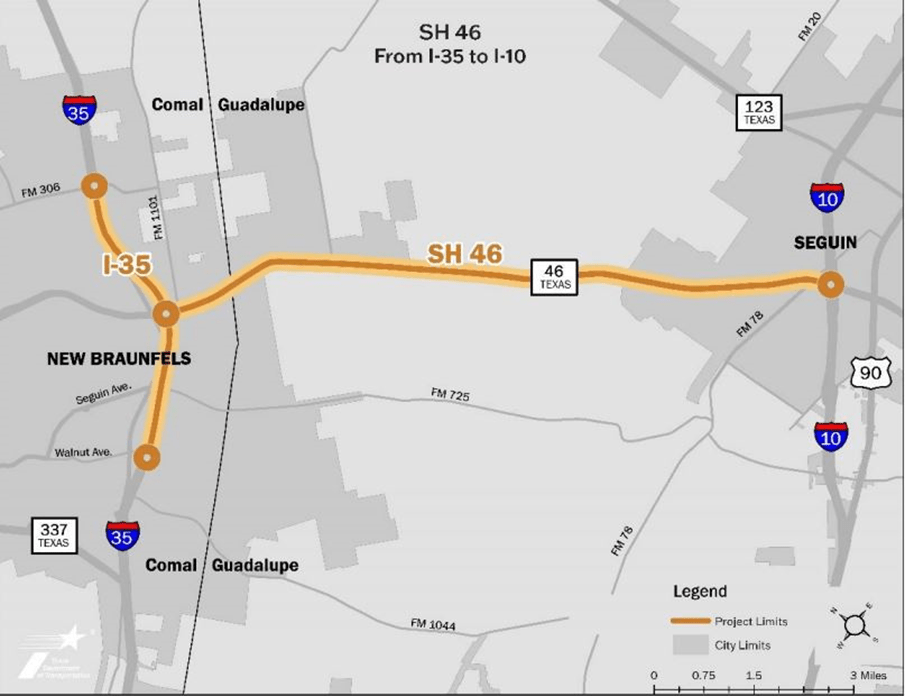
The Texas Department of Transportation (TxDOT) is proposing to improve SH 46 from I-35 to I-10 and I-35 from South Walnut Avenue to FM 306 in Comal and Guadalupe counties, Texas. Due to current and future traffic volumes and regional population growth, the proposed project’s goal is to reduce congestion, improve mobility and increase safety along SH 46.

In order to accomplish this, TxDOT is looking to expand SH 46 with additional lanes, overpasses and intersection improvements. This 15 mile project will require additional right-of-way to its existing 120 feet right-of-way and potentially displace property owners and existing businesses.

 This project is in its preliminary stages as funding for some of these improvements are included in the Alamo Area Metropolitan Planning Organization’s Metropolitan Transportation Plan, Mobility 2050, which is awaiting federal approval. The proposed project must still be environmentally cleared, schematics finalized, and funding identified.

US 29/SH 36 Interchange – Central Direct Connect

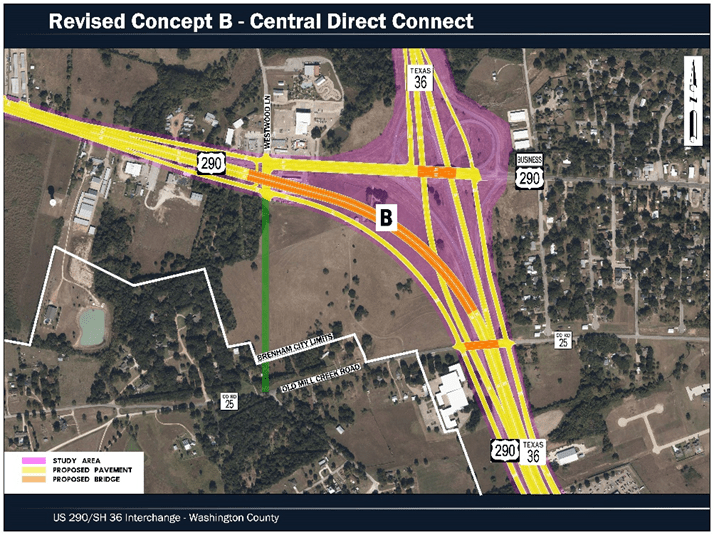
The Texas Department of Transportation (TxDOT) will be making improvements to the intersection of US 290 at SH 36 in Brenham, Texas in a planned project called US 290/SH 36 Interchange – Central Direct Connect. TxDOT originally considered three concepts that were presented and shared with Brenham City Council and Washington County Commissioners Court. Based on feedback from the City and County, TxDOT developed two additional concepts for a total of five concepts. In Spring of 2021, TxDOT announced that Revised Concept B – Central Direct Connect was the selected alternative for further development. All concepts include the following: (i) the expansion of US 290 at SH 36 connection from one to two lanes; (ii) convert frontage roads one-way; (iii) update the entrance and exit ramps to current standards; and (iv) accommodating bicyclists and pedestrians within the urban settings.

TxDOT is anticipating a Public Hearing early 2023. TxDOT is currently undergoing its environmental review process which is an essential part to a finalized route. See the timeline below for anticipated dates of right of way acquisition (expected 2024-2025) and construction start date (expected 2026).

Project Connect Light Rail in Austin

In November 2020 Austin voters approved an expansion of Austin’s public transit system through a project called Project Connect. When voters approved the project it was estimated to cost $7.1 billion, however, the estimated cost has since risen to $11.6 billion. The Austin Transit Partnership (ATP) has said the increased costs are due to increased labor and material costs, and increased property values for the land needed for expanded right-of-way (ROW). In response to growing costs the designs for the project’s planned light rail lines have been revised. At a public Open House on March 21, 2023, the ATP unveiled five possible design options for the revised light rail system.

All five light rail design options presented propose a significantly smaller system than what was previously planned. The original planned light rail system included two train lines and about 28 miles of track. Of the five new light rail design options, the longest option only includes about 12 miles of track.  Two of the options presented include only street level track, two options include elevated portions of track and street level tracks, a final option includes a small underground section of tract with the rest of the track at street level. All five options propose slightly different routes for the system. The option with the furthest north route stretches to a proposed new North Lamar Transit Center on Lamar Blvd. north of US Hwy 183. The furthest south reaching option stretches to a station on South Congress Ave. near St. Edward’s University. The option that travels the furthest eastward would reach Austin Bergstrom International Airport. None of the options presented would travel further west than North Lamar Blvd. The Austin Transit Partnership did indicate that it views these smaller proposed designs as merely a starter system with the ability to expand any of the options in the future. However, there are currently no proposed future plans for expansion of the system beyond the five design options presented.

All five light rail design options will require an expansion of the ROW along the lines’ routes. Until a final design is chosen it is not possible to determine exactly which properties will be impacted by ROW expansion. The ROW expansion is expected to displace residents and the project’s budget currently dedicates $300 million to displacement issues. It is unknown if the current concerns surrounding the project’s cost will affect this displacement budget. The Austin Transit Partnership is currently taking public feedback on all of the design options and plans to choose a final design in June 2023. ATP expects the earliest the process for acquiring new ROW could being is sometime in 2024, with although ATP stated that the process of taking a few unidentified parcels of land could begin as early as 2023.